
CORNER MARSHAL'S MANUAL
TABLE OF CONTENTS
INTRODUCTION
The Corner Marshals Manual has three objectives:
Directed mainly to the new marshal, and oriented to the conduct, procedural and safety issues of road- racing, it is hoped this work will be essential reference material to the novice marshal and offer useful reminders to the seasoned veteran.
Often working under very uncomfortable conditions, rain or shine, marshals are the foundation blocks of motor racing. Without them there would be no motor racing.
In addition to referencing the principles of corner marshaling and motor racing safety in the FIA Yearbook and ASN competition regulations, this work relies on many years of personal experience of many dedicated workers.
2. NOTICE TO READERS AND USERS
This manual provides guidelines and information on many road-racing situations affecting the corner marshals, or in which the corner marshal is likely to be involved.
To compose this manual it was necessary to assume a typical race organization structure in order to establish job relationships and communications. Officials' titles and brief job descriptions are included and several race procedures are discussed.
Much effort has been made to ensure accuracy, however, it need be recognized that all circumstances and eventualities cannot be anticipated or described in minute detail. The traditional concept of common sense prevails in corner marshaling as in any other endeavour.
Neither the author nor the contributors can be held responsible for any inaccuracy that may appear. The manual must be read in conjunction with the regulations for the day of a specific race event.
3. ROLES OF THE WORKER
The role of the corner marshal is to:The fact that motor racing can be dangerous must be understood and accepted by all who participate at road-racing events. There is exposure to personal injury simply because of the proximity to the race track, fast-moving vehicles and incidents that occur in the normal course of racing.
Personal risk is minimized as familiarization with, and adherence to the guidelines increases. However, there is no room for complacency or unnecessary risk-taking.
If at any time you are in doubt as to how to act in a situation, pause and seek advice from your Corner Senior, and those more experienced around you.
4. THE CORNER MARSHAL
Next to the competitors, the corner marshal is the most visible person on the track. The corner marshal is viewed by the spectator as an integral part of the race, keeping the track clean, giving instructions to the drivers, and responding to incidents.
4.1 Corner Marshal's Dress Code
The corner marshal's standard dress code is white clothing. Please refer to the Firefighting section for tips on clothing and how to make cotton and denim fire-resistant.
4.2 Preparing for a Day on the Job.
A new marshal soon learns to assemble a standard "kit bag" to take to all race events. You will want to assemble your own check list, but make sure to include gloves, sturdy boots, hat, sun screen, whistle, ear plugs, log books, etc.
As with any organization, there must be standards of individual conduct to maintain a sense of order:
On arrival at the track each day you will report to Chief Corner Marshal who will assign you to a Corner Senior, and a corner post location for the day. Remember to submit your log book for endorsement.
Plan to arrive at the assigned post at least 30 minutes before the start of the days activities.
You must ask your Corner Senior for a full explanation of your job and become familiar with the layout of the post, including the location of all post safety equipment. Make sure your equipment is in good working condition and you know how to use it, particularly fire extinguishers.
Make sure procedures that take place at a corner post during a weekend are pre-planned as to who does what should an incident occur. Make sure you discuss this with your Corner Senior and fellow marshals.
"A corner marshal should be courteous at all times . . . " is good advice but do not confuse this with the desire to make comments about race incidents to the press, public or competitors. Things are not always what they appear to be and people could be misled based on speculation; there are other officials who will make comment to those who need to know when proper enquiries have been completed.
4.5 Typical Corner Organization
The Corner Senior or Captain:
Assures that:
4.6 Other Position Descriptions
Communicator - Relays information between the station and control. Maintains corner log book. Acts as an observer at the station.
Yellow Flagger - Watches racetrack to the next downstream station, assesses incidents and displays yellow flag(s) as required.
Blue Flagger - Watches oncoming traffic to ensure the yellow flagger's safety, displays the blue flag and other flags as required.
First Response - Responds to incidents on or off the racing surface, assesses the situation and relays information to the stations.
Spare - The spare assists all other corner workers as requested by the Corner Captain. The spare also acts as an observer and reports to the Corner Captain as required.
4.7 Minimum Corner Post Equipment
5. DESCRIPTION OF RACE OFFICIALS
Roadracing, because of the large area over which the event occurs, and the number of people involved, requires a bigger organization than most sports. Smaller events may operate with fewer officials. Brief job descriptions of the officials generally in attendance at a National race meeting are noted below:
Clerk of the Course - The Clerk of the Course controls the race track at all times, whether a competition is in progress or not.
Deputy Clerk of the Course - Performs duties assigned by the Clerk of the course, generally involving the competitor.
Race Central Chief Communicator - Maintains communications between the corner posts and the Clerk of the Course during the running of events. Records all incidents in a daily log.
Chief Course Marshal - Attends to the overall organization of the corner marshals.
Assistant Course Marshal - Performs duties assigned by the Chief Corner Marshal. Usually responsible to assure corner post equipment is delivered to and collected from each corner post.
Chief Starter - Attends to the starting and finishing of all races.
Assistant Starter - Under the direction of the Chief Starter, assures cars leaving the pits do so properly.
Chief Paddock Marshal - Maintains organization of the race car paddock area.
Pre-Grid Marshal - Assembles the cars in the proper order prior to the start of a race.
Chief Scrutineer - Performs the technical inspection of all cars prior to going onto the race track.
Chief Registrar - Assures all competitors and officials are properly registered and issued with credentials.
Chief Timekeeper - Performs timekeeping and lapscoring.
Pace Car Driver - Assists the Clerk of the Course in maintaining control of the race cars.
Chief Pit Marshal - Establishes and maintains control in the pit area.
Race Stewards - Appointed by the Sanctioning Body to monitor the organizers compliance with general rules and regulations, and to assist in the resolution of disputes arising from rule infractions.
6. CORNER POST COMMUNICATIONS WITH RACE CONTROL
The management and control of a race requires that all information relating to inappropriate conduct of cars be reported to Race Control.
The Clerk of the Course appoints a Race Control Communicator. This individual works in Race Control and maintains communication between the Corner Post Communicators and the Clerk of the Course for the duration of the event. This individual keeps a written record of all track incidents reported by the Corner Post Communicators.
The type of information includes:
Cars that spin without hitting anyone else, competitors who have their own accident with a bank or barrier; constitute incidents that require only a straight forward and speedy report to Race Control. The incident is also to be recorded on the Corner Senior's daily log. Four wheels off must be reported - Two wheels off three times during a session is reported.
A spin or off-track excursion may seem insignificant by itself, but if a driver is pursuing the same erratic course elsewhere, the Clerk may want to have the driver black-flagged for a discussion, so a brief call should be made to Race Control.
The same applies when a car has some mechanical component flapping about -- exhaust, body panels, hood, etc. Sharp eyes are needed for similar reports are required should a car be dropping fluid, or a driver does not have the helmet properly fastened, or the window net is not up.
Each report should be based on fact, not conjecture or opinion.
Special reports are necessary where grave injury is inflicted, and extra trouble must be taken to record the facts, and a sketch made of the circumstances.
6.2 Style of Incident Reporting
Provided below is an example of a report of a serious incident, given by the Corner Communicator to Race Control, as it develops. This provides the Clerk of the Course with sufficient information to know what is happening and to make a decision if necessary.
The Corner Communicator begins every separate transmission with "Corner 8 to Control", reports the flag status, "Standing Yellow", and waits confirmation from Race Control before giving the message.
As events unfold the transmission continues:
The Race Control Chief Communicator will acknowledge and record each of the transmissions.
7. FLAGS
For a detailed description of flags, refer to Organizing Manual, Section 16.0.
Corner Workers use a number of coloured flags to communicate information to drivers about conditions on the track. At each station, one worker operates the yellow flag, and watches downstream as cars leave his or her flagging area. Another worker operates all the other flags. He faces towards the yellow flagger, and watches the cars coming towards the station.
The description that follows concentrates on the correct procedure for Yellow Flagging, since this is something every worker should understand.
The description of the remaining flags is quite brief, and it is intended only to give an overview. Some of these flags require time to master, and can only be learned through experience trackside.
The yellow flag is used to warn drivers at or beyond your corner post. Usually the danger is one or more vehicles involved in an incident, which are either stopped or trying to regain control and rejoin the race. When approaching a station displaying a yellow flag, drivers should slow down and proceed with caution until they are clear of the emergency area. When the yellow flag is displayed, drivers cannot pass one another until after they are clear of the emergency area.
There are three 'levels' of yellow flagging used to tell competitors of the nature of the hazard they are about to encounter. The major types of situations that may arise in your flagging area, and the appropriate yellow flagging response, are as follows:
A hazard off the track surface is indicated by a SINGLE stationary yellow flag. This is used when the driver can take his normal path on the section of the track past the incident. It is simply meant to warn drivers that there is now a hazard, off the track, where usually there is none.
A more serious situation involves a hazard on the track surface or in any dangerous position just off-track. This type of situation is indicated by a SINGLE waving yellow flag. The waving motion is intended to attract the driver's attention, and emphasize the hazard ahead. It is used to warn the driver that he may have to change the way he normally drives as he passes the incident. For instance, he may have to adjust his path in order to avoid hitting a stopped car. If a hazard is in a dangerous position such as the outside of a difficult turn, the driver may have to slow down more than usual, in order to avoid the chance of sliding off the track and into a disabled vehicle.
The most serious situation involves a stopped car blocking the most-often used part of the width of the track, called the 'racing line'. Blockage of Racing Line is indicated by TWO waving yellow flags. Since the racing line is part of the track the driver normally uses, the double waving yellow flags indicate he should be prepared to take drastic action to avoid becoming involved in a collision. For instance, he might have to be prepared to come to a complete stop, or even to leave the track surface. Double waving yellow flags represent the highest level of warning you can give a driver, and so should be used sparingly, and only as necessary.
As you can see, correct use of the yellow flags involves making a lot of judgment calls. The above rules of thumb give you the basic idea behind each of the three levels of yellow flagging. But situations are constantly changing, sometimes requiring you to change the level of yellow flag you are displaying as an incident evolves. Again, the basic levels and their appropriate flagging response are:
mild hazard - single stationary yellow flag
serious hazard - single waved yellow flag
very serious hazard - evasive action required - double waved yellow flags
Learning to identify the various levels and respond appropriately is a matter of experience. If at any time you are unsure whether the flags you are using are appropriate to the situation at hand you should always feel free to check with you Corner Captain.
The most important thing to remember is not to allow your judgment to be affected by the severity of the incident, or by your own level of excitement. For example, a car stopped thirty feet off the track requires, at most, a stationary yellow flag, regardless of how spectacular the incident was that got him there. A car well off the track - whether it has crashed, or even if it's on fire - simply doesn't require any action on the part of drivers trying to safely negotiate your portion of the track. Just remember that the yellow flag is for the drivers, and must give them useful information about what they are going to have to do in response to an incident in your flagging area. If you can master this simple idea, you're well on your way to being an effective Yellow Flagger.
What to do when there's a serious incident at the station after your station.
When the next flagging station after yours is dealing with a serious incident (that is, an incident requiring them to display Single Waved or Double Waved Flags) your station is responsible for giving additional, advanced warning to drivers passing your flagging station. You do this as follows:
The idea behind this procedure is simple - it gives drivers additional warning in case of a serious incident ahead, and prevents drivers from trying to pass just before they enter an emergency area. While this part of the yellow flagger's job does not require as much judgment as an incident in his or her own flagging are, it does require one to pay careful attention to the flags at the following stations.
But there are exceptions to this rule: When, for instance, there is a fair distance between two corners, and drivers will have a long time (and good visibility) to see the waved yellow flag as they approach the corner, it may not be necessary to shut down such a large proportion of the racetrack for the incident. In such a case, the preceding corner will not need to display a standing yellow flag when the downstream corner is displaying a waved yellow flag. This, of course, will depend upon individual racetrack configurations, and may well vary according to weather & visibility conditions.
FULL COURSE YELLOW: When there is a serious hazard on the track, or when an incident may require quite some time to clean up, the Clerk may call for a full course yellow and send out the pace car. This flag consists of both of the yellow flags held together in a rectangular configuration. Full course yellows are never waved, just held.
The remaining flags are used to convey the following messages:
 | Blue Overtaking Flag |  |
Green Road clear |
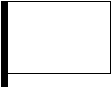 | White Service car or slow moving vehicle | 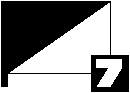 |
Black/White diagonal Warning flag |
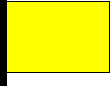 | Yellow Danger | 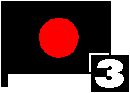 | Black,
Orange disc Mechanical failure |
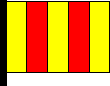 | Yellow/Red Slippery Surface | 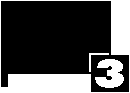 | Black Report to Clerk of Course |
 | Red Cease Racing | 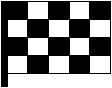 | Checkered End of race |
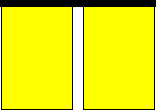 | Full Course Yellow Cease Racing Proceed as if under Pace Car control |
It is best if the flaggers work in pairs. One with BLUE, and the other with YELLOW and the other danger flags. The BLUE flag looks towards the oncoming cars. The YELLOW looks downstream to observe any incidents in the corner's area, and at the flag status of the next station. Wherever possible, the yellow flagger should position himself in such a way as to be able to keep an eye on incoming traffic as well as his area of responsibility downstream.
Handling the YELLOW flags means that the flagger concerned cannot watch oncoming traffic, so must be placed slightly upstream of the partner in the face-to-face disposition, so that the sighted flagger can warn the other of impending danger. (This is the blue flagger's primary responsibility.) They can also exchange information readily in a BLUE or YELLOW flag situation. In a YELLOW situation, the two flaggers quickly pivot around each other so that the yellow flagger faces oncoming traffic. If the yellow flagger can make "eye contact" with the drivers, he can flag more effectively. The blue flagger advises his partner of the status of the incident. When the incident has been cleared, the flaggers switch back to their former positions. It's important that the flagging team works out in advance the mechanics of this "pirouette" so that in a yellow situation it can be undertaken quickly and cleanly. In some quickly clearing incidents, such as a spin & continue, this pivoting action may not be necessary. The yellow flagger can be the judge of this.
As mentioned above, the blue flagger's primary responsibility is the safety of his yellow flagger, and his entire crew. Except in a yellow situation (when the yellow flagger is looking upstream) The blue flagger should always be observing oncoming traffic in order to be able to warn his corner of any imminent hazard. A whistle is essential, and it can be worn in one's mouth during the opening laps of some sessions. A short blast on the whistle can be taken as "heads up", and a long blast as "take cover" -- establish this, and establish clear escape routes & procedures at the morning corner meeting. In the event that the blue flagger is also "first over", the Communicator or the Corner Captain should take over the duty of observing oncoming traffic during the absence of the blue flagger.
During a race, it's often impossible for the flaggers to communicate verbally, so it's important for the flaggers (and indeed the entire corner) to work out a series of hand signals by which they'll communicate. In advising your yellow flagger of any possible hazard, a whistle blast or a "tap on the shoulder" can be sometimes unnecessarily startling. Grasping your yellow flagger on the shoulder, and directing his attention to the developing incident can be very effective. In this way you'll be in a position to steer him the right way if the incident becomes hazardous, and he'll be aware of (but not startled by) the possible need for flight.
8. HAND SIGNALS
Hand signals are a means of communication that have been developed by track workers all over the world. In the midst of a race, vocal communication is often impossible. With experience, the signals below can be used to communicate most of the information that one needs to convey at trackside. It's extremely important to note that these signals may well vary from track to track, and region to region; and must be interpreted within their context. Be sure to establish which hand signals you will be using at your corner. In choosing which system you'll be using to indicate numbers, it's important that everyone on the corner can both send and read the signals.
The underlying rule is common sense. Most of us use some form of hand signals every day and some signals like "come here", etc. are so obvious that they're not included. So don't get so wrapped up in technicalities that you fail to "see the forest for the trees". This system is an elaboration of a "universal" language that applies specifically to motorsports.
Although this list is extensive, many of these signals are used only rarely. Familiariy with them all, however, can make communications easier, and make your trackside experience a lot more fun.
And don't be self conscious about practicing these signals between races. It takes a fair amount of work to be able to use these signals reflexively. It'll amuse & intrigue the crowd, & contribute to our "mystique" . . .
These signals are always "Mirrored". On receiving the signal, send the same signal back. This will assure the sender that the message has been seen and understood. And in cases such as "full course yellow", "checkered flag", "pace car", etc. everyone mirrors the signal so that workers across track & downtrack will receive the message.
(NOTE: Another list of hand signals is contained in the Motorsport Marshalling Services' Manual in the Hand Signals section.
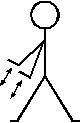 |
Slow Down: To make this signal, hold your hands out in front of you, palms down and move them up and down together. This signals the drivers to slow down and is usually used during a pace lap to keep the driver's from racing too early. It can be used in advance of an incident to slow down drivers who may have not "seen" the yellow flag -- especially when workers are on the track. |
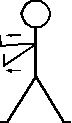 |
STOP: Hold your hands, palms up, in front of you, push them rapidly ahead & hold. This may be repeated a couple of times. For emphasis, you may use the "kill" or "red" signal before this sign. It's used to stop a car if there's no way through or around an incident, and the car must stop. NEVER count on the car stopping. Stay out of the path. The sign may also be used to indicate to a worker NOT to cross the track. |
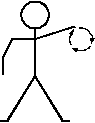 |
Speed Up: "Spin your wheels"; A rapid circular action with one hand. This signal is used almost exclusively as a direction for the pace or lead car to speed up on a pace lap. |
 |
Bunch Up: This signal is made by holding your hands up and slowly "clapping" them. This signals the drivers to close up. It is generally used on a pace lap as the cars are approaching start/finish to begin the race. |
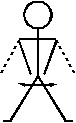 |
Spread Apart: Hold your hands together in front of you, then spread them apart. Repeat this a few times. Usually used during practice, this signals the drivers to space out if they are too close together. |
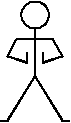 |
Line Up Double File: Hold your hands up two or three inches apart, palms in and move them back and forth alternately toward and away from you. This signals the drivers to form up a two by two grid as they approach the Start/Finish Line during the pace lap. |
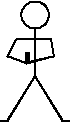 |
Line Up Single File: This signal is similar to the Double File signal except that your hands are in front of the other instead of apart. As you might expect, this signals the drivers to line up single file. |
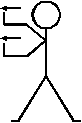 |
Push: The intention is to indicate to the driver that the track is clear on the side opposite from where you are standing. Use a deliberate motion of the hands starting at the shoulders and thrusting them outward until they are fully extended. The signal is more effective if the body leans in that same direction at the same time. Palms facing out from body. |
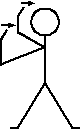 |
Pull: This indicates the track is clear on the side on which you are standing. This starts with the arms fully extended and then draw them into the shoulders in a deliberate motion. Again, if the body moves in the same direction as the arms, it emphasizes the motion. Palms facing into the body. |
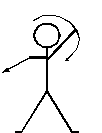 |
Avoid this Area: With a large arcing motion of your arm, direct the oncoming car around the incident and point out the pathway. Especially if the incident cannot be easily seen by oncoming traffic, you may point at the incident with your opposite arm. "Avoid THIS area . . ." |
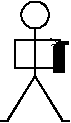 |
Your Car is On Fire: Hold up your fire extinguisher and point to the car. |
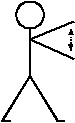 |
You have a flat tire: Hold out both arms to your side, and bring them together slowly a few times. |
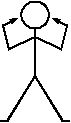 |
Lights On: Used in Ice Racing; To make this signal, point first at your eyes with both hands, then at the car in question. This is used for cars that don't have their headlights or rear fog light on. It is very important that Ice Racer's have their lights on so that the marshals can see them but more importantly so the other cars can see them through the ice fog. |
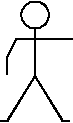 |
Stationary Yellow: Arm held at right angles to body in steady unmoving position. This signal is used to call for standing yellow at the corner. |
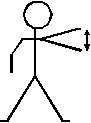 |
Waved Yellow: One arm held outright and waved vigorously up and down. This signal is used to call for a waved yellow at the corner. |
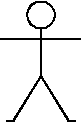 |
Double Yellow:
Both arms held straight out. This is the same signal as that used for a flat tow, but it's context makes it
obvious. This calls for two standing yellows, and is only used as an advance warning of a double waved
yellow situation at the next corner. Please note that the flags are held separately. IMPORTANT: The WCMA is one of only a few regions which employ two standing yellow flags as an advance for a double waved yellow. Indeed, some regions don't employ a double waved yellow either. And it has become common practice in some regions to use the arms extended "double yellow" signal to indicate "full course yellow". Be sure that these signals are worked out & understood by your corner. For example, if the yellow flagger observes a double waved condition at the station downstream, he should display two yellows, held separately. If, however, the communicator indicates "double yellow", they might well be calling for a "full course yellow". |
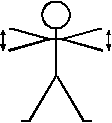 |
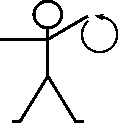
Double Waved Yellow: Both arms held straight out and waved up and down. Your captain appears to be trying to fly. This calls for a double waved yellow. |
 |
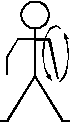
Full Course Yellow: Describe a large circle with one hand, while holding out the other arm atraight. Used by the Corner Communicator or Captain to call for a full course yellow when ordered by Race Control. The flags are held together, side by side in a rectangular configuration. Again, establish the signalling regime in your corner at the morning meeting. The Communicator or Captain might use a "double yellow" signal to call for a full course yellow. |
 |
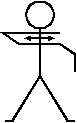
Pace Car: A windmill action with one arm. This signal is used to indicate the prescence of the Pace Car on the track. Essentially, it's the SAME signal as the "Full Course Yellow. If the Pace Car's on, it's full course yellow -- an interesting study in "linguistic divergence" among Course Marshals . . . |
 |
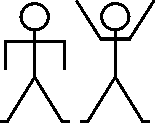
Red or Kill Signal -- ORDERED BY RACE CONTROL: This signal is sometimes used as a signal to cease an activity, or to remove a flag, etc. although the "cancel" or "all clear" (below) is generally preferred. In some cases, it could be used (for example) by a worker at the scene of an incident to indicate that the engine has died, etc. Here, as well, context is important. In most instances, it will be used by race control (or your communicator) to order a red flag. In this latter case, marshals should be completely certain of the intent of the signal. " Oops I'm sorry about that red flag " usually doesn't get you too many free beverages from the drivers. Please note that some events do not employ a red flag, but display a waved black flag at all corners -- indicating that all cars should immediately return to the pits. Control will call for a "red flag", and the communicator will indicate with the red flag signal -- but the flagger will be waving a black flag. |
 |
White Flag: Form upside down 'W'. (Or, in some regions, form a "right side up" 'W'.) Slow moving or service vehicle. Note that some workers will tug on their whites (around shoulder level) to indicate this flag. The white flag is held stationary for a slow moving vehicle. When a service vehicle is in your station, the flag should be waved. When the vehicle has proceeded into the next station, that station will wave the white, and your station should display a standing white until the downstream station goes to a standing white. At this point the flag should be removed. Please note also that current SCCA rules require a standing white at TWO stations to warn of a service vehicle -- no waving white. |
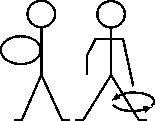 |
OIL Flag or SURFACE Flag: These two signals are synonymous. In the first case, form the letter 'O', and in the second case, point to the track & describe a circle. This signal is used to call for the red & yellow striped "oil" or "debris" flag. You should note that "anything bigger than a breadbasket" -- any debris which may be a real danger to a car requires the display of a yellow flag. Also, the prompt display of this flag if there is oil or gravel etc. on the track is important -- it could prevent a messy incident when the condition is encountered. (So be sure to clarify which signal is going to be used, and/or understand both.) This signal, when preceeded by the "check" signal (below), or a "questioning" motion may be calling for you to check the track for oil or debris. |
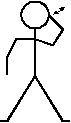 |
Meatball: Tap the back of your head with your fist. |
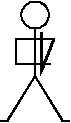 |
Black Flag: Cross one arm over your body, and hold the opposite fist to your chin. |
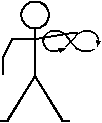 |
Checkered Flag: A waving motion describing a "figure eight". Usually used by the Corner Communicator to indicate that the Checkered has been displayed, but may be used by Race Control to inform the Starter to display the Checkered. |
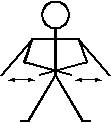 |
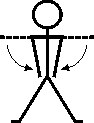
Cancel: Sometimes used as Green/All Clear: Both hands across lower body and moved rapidy from side to side across the front of the body. Used in a number of different circumstances. e.g. cancel the flag; tow no longer required; everything is okay; the track is clear; the incident is under control . . . |
 |
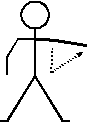
Withdraw Flag: This is similar the the "Cancel" signal, but is more specific. It's a signal to "Put the flag down." In some situations, where your view of the track is impaired, and your Chief may be signalling to other stations during the course of an incident, it's very important that you wait until you recieve a clear "Withdraw Flag", or "Flag Down" signal before removing your flag. |
 |
Check: describe a large check mark with one arm. This is a signal to check a condition. It will be followed by a signal for oil or fluid or a car number, etc. Please note that Californians (& others) might be wiggling their hands in a "questioning" type of way. If there's a puzzled expression on their face, this is their way of asking you to check something. |
 |
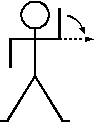
I need a point: This is a request to your captain or co-worker for directions in crossing the track. A single raised arm may be used by some workers to make this request. |
 |
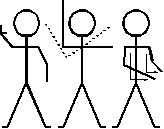
Last Car: Point to last car as it passes. |
 |
Last Lap: Several signals can be used for this. To indicate last lap to workers nearby, just form the letter "L" with your thumb and index finger, and close it a couple of times. For workers across the track or at some distance, form the "L" with your arms, and rock it back & forth a couple of times. Some workers will use an upraised finger on two hands to describe a double "L" in the air in front of them. |
 |
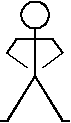
Lap: Squat slightly, and pat your "lap". |
 |
Half Way: Arms crossed. |
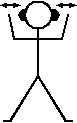 |
Phones (or Radio) Not Working: Tap your headphones with both hands. If you're not wearing headphones, pretend. |
 |
Passed: This is used to indicate that a car has passed another. Hold both hands in front of you, palms up, one above the other. Bring the lower palm up around to the top. It would generally only be used to report that a car has passed under yellow. Indicate "car number", "passed", "the number of the car that was passed", then hold out a single arm to indicate yellow. The second car number is not nearly as important as the first. He won't be getting a black flag. |
 |
Front: To indicate the front of a vehicle, pat your belly. |
 |
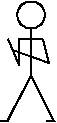
Rear: To indicate the REAR of a vehicle, pat your behind. (And don't be using your communicator's behind for this purpose.) |
 |
Right: To indicate RIGHT SIDE , raise your right forearm and grasp it with your left hand. In using this and the "left" signal, and mirroring it, don't forget that the person signalling "right" to you will be grasping the arm to your left. |
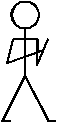 |
Left: To indicate LEFT SIDE , raise your left forearm and grasp it with your right hand. |
 |
Spraying: Make a fist, hold it to your mouth, and move it away while splaying your fingers. This is to indicate that a vehicle is spraying something. |
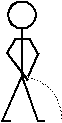 |
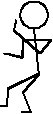
Leaking:
Yes, boys and girls, this little stick man is taking a leak. No, we couldn't think of anything else. For clarity,
one might weave around a bit, pretending to write one's name in the snow. It is understood that this may
require a certain amount of imagination on the part of the female marshals, and in certain cases, might
offend a few delicate sensibilities. But sometimes, kids, certain sacrifices have to be made.
It has been strongly argued that a more "politically correct" form of this signal be devised, but the simple fact that a marshal squatting behind a wall can't be seen by anyone makes this impracticable. This signal (well maybe not so) obviously means that the vehicle is leaking something. |
 |
Smoking: Pretend you're puffing away on a big Havana cigar. (Unless you're in the 'States and are forced to use a domestic variety.) This is used to report that a vehicle is smoking |
 |
Fluid: Pretend you're drinking something. Most often this signifies engine coolant, or water. Use this sign when a car is "leaking" or "spraying" fluids. |
 |
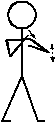
Front Wing: To indicate a front wing on a car, bring your finger to your nose (sobriety test), while flapping your opposite arm as a "wing". |
 |
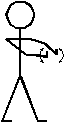
Rear Wing: This is the same as the above signal, except that your arm is reached around to tap the back of your shoulder. |
 |
Driver: To make this signal, hold your hands out in front of you, grasp & wiggle an imaginary steering wheel. It indicates the driver of the car, & may be used for such things as a captain calling for a marshal to "bring the driver back to the corner, NOW!", etc. |
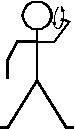 |
Goofy: Hold a finger near your ear, and describe a few circles. This signal may be used in the phrase: "Driver, Car 1, Goofy" in the event that Alex Zenardi hits the wall during a pace lap. Another appropriate phrase might be: "Driver, Car 1, Out of Fuel," then point to your head. |
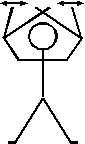 |
Driver OK: Arms crossing over the head. This is the first and most important piece of information that should be conveyed from the scene of an incident. The quickest way to ascertain if the driver is OK is usually to give him the "thumbs up" in a "questioning" type of way. If the driver nods or returns the "thumbs up", signal that he's OK to your corner. (Or the nearest position with a communicator.) Note that marshals from some areas use the "driver" signal followed by baseball's "safe" signal. The "safe" signal is similar to the "cancel" signal, so if you see a worker cancelling a driver, you can probably assume that the driver is OK. |
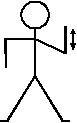 |
Alert: Pumping the sky motion. This is a quickly noticeable signal to inform your corner of an alert situation. |
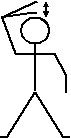 |
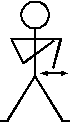
Worker Needs Assistance: Rapidly tap the top of your head. |
 |
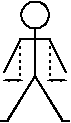
Driver Injured: "Broken Wing Signal". One arm dangling & waving back & forth. The arm may or may not be supported by the opposite arm. |
 |
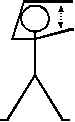
Driver Requires Extrication: Hold your arms against your sides and "open & close" them. Meant to represent a "prying" motion. This signal is rarely, if ever, used. By the time a marshal makes this signal, safety and the ambulance should be already doing the job. |
 |
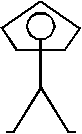
Driver Requires Extrication: (Alternate signal) Note that workers in some regions use the signal at left to call for extrication. |
 |
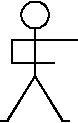
Ambulance: Form the letter 'A' above the head. |
 |
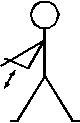
Fire Truck, or Fire: Form the letter 'F'. This is the most common signal used to indicate fire. Note that the "pump" signal below is sometimes used, and that workers in some regions raise one arm in the air & spin it in a circle to signal "fire". |
 |
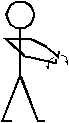
Fire Bottle Needed: Hold forward one arm, and "pump" with the opposite fist. Note that this signal is sometimes used to indicate "fire", but it should be only used as a "fire bottle" signal. More often than not, a fire bottle is brought to an incident as a precautionary measure, even though no "fire" is yet indicated. Most commonly, your captain will use this in signalling you to go to an incident, taking a fire bottle with you. |
 |
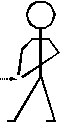
Broken: Hold your arms in front of you, and make a motion of "breaking a stick". This may be used to indicate that "Car X is Broken". |
 |
Dragging: Make a motion of dragging a heavy object. This signals that a car is dragging something. (a muffler or a body panel, etc.) |
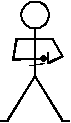 |
Impact: Smack your fist against your opposite palm. This indicates that a car has "impacted" something. |
 |
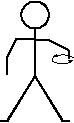
Side to Side Contact: To indicate side to side contact between vehicles, hold out your palms at a 45 degree angle in front of you, and bring them together a couple of times. |
 |
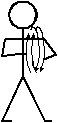
Car Spun: Hold your hand out in front of you with one finger pointing down, and describe a small circle to indicate that a car is (or has) spun. |
 |
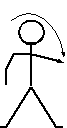
Rollover: Circle both of your forearms in front of you. If the car is on it's roof and blocking the track, this would probably be preceeded by an "alert" signal. It would be followed by the car number if you can see it. If the car has rolled off the track, indicate that, and whether on driver's right or left. |
 |
Car Off Track: This signal is rarely used as it is usually pretty obvious when a car has left the track. In some instances, however, a driver may have his roadmap upside down and end up off in the bullrushes in the middle of a slough halfway to the next county. Nobody may know where he is. The signal is similar to the "avoid this area" sign. Signal the car number, make a large arcing motion with your arm, pointing to the position of the car, ("way over there") and indicate "driver's left", or "right". |
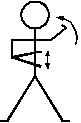 |
Car Out of Fuel: Rub your belly with one hand, while bringing the opposite arm back & pointing over your shoulder with your thumb. "Fuel gone". |
|
|
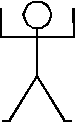
Flat Tow Required: Form the letter 'T'. The car is disabled, but can still roll. Send a truck to perform a flat tow. |
 |
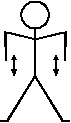
Wrecker, or Lift Tow Required: Form the letter 'W'. The car is damaged and must be removed from the track with a lift tow. Note that Marshals in some areas use the "volleyball scoop" to call for a lift tow. This is performed by placing both hands together near the ground, and "lifting" them into the air. |
 |
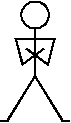
Now!: Rapidly pump the arms towards the ground. Some workers will use only one arm for this signal. |
 |
Number Signal: Cross your arms in front of your chest. This signal is used to indicate that you are about to signal a car number back to your corner. The method of signalling numbers is explaned below. |
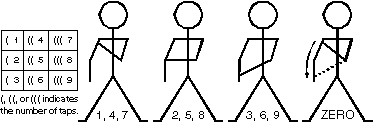
As with all hand signals, one should perform the numbers "theatrically". Motions should be large and dramatic so that they can be clearly seen from a distance. The first system described is the preferred method, but it's a bit complicated, and requires practice in order to achieve proficiency. It's advantages are it's clarity and its brevity. Again, be sure to check with your captain on which system you'll be using.
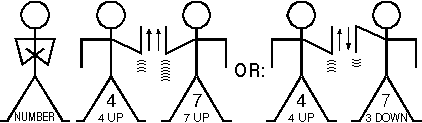
In a two or three digit car number, switch arms between digits. And before beginning the number, use the "number" signal. Also, if reporting two car numbers, use the "number" signal between the car numbers to indicate that they're separate.
Example: To report car number 48, use the following signals:
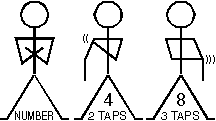
Example: To report car number 47 use the following signals:
 |
Acknowledge: A driver may wave or touch the brim of his helmet to acknowedge a flag or a signal. |
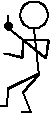 |
Humbly & Graciously Acknowledge: This signal is usually used to acknowledge a black flag. The driver reaches through his window netting, makes a fist, and raises his middle finger. The single finger indicates that the Track Workers are "number one" in his books. |
9. RACE OFFICIALS
It is important to recognize that just as there are new corner marshals at race meetings, so there may be new race officials.
Any changes in the days events, corner marshals routine or procedures must be authorized by the Clerk of the Course.
Should you be approached by a race official, or anyone for that matter, summon your Corner Senior at once. Should your Senior not be available, listen carefully to what the official is saying, and politely state that you will convey the message to the Senior, and then make sure you do.
The exception to this guideline is the situation when additional resources arrive to assist your corner crew, for example in an emergency. In this case, common sense and good judgment should guide your response.
10. RACE DRIVERS
Driving a race car at high speed around a race track can create predictable effects on some drivers, particularly should the car be forced to come to a stop quickly, for whatever reason.
The driver emerging from a car that has stopped quickly requires a few moments to adjust to the absence of speed, and may be momentarily disoriented, appear to be dizzy, and inclined to wander around, perhaps even wanting to cross the track to return to the pit area. Also, depending on the reason for stopping, the driver may be angry, adding to the situation.
11. RACE CARS
Race cars come in many different sizes and shapes, and the methods of construction differ significantly from one to another. Also, the speed of cars varies considerably.
Some common things to remember, when working around cars that arrive at your corner for whatever reason, are noted below:
Always be careful around race cars, particularly when they have been involved in an accident.
11.1 Electrical Switch Symbols
The technical rules for the cars require that a master electrical switch be located in a readily accessible location on the car.
The switch is designed to disconnect the positive side of the battery, cutting off all power to the cars wiring system. When activated, the risk of fire from an electrical short-circuit is minimized.
The switch is found in several locations, generally towards the area rear-ward of the driver.
It is necessary to make sure the switch is turned off after an accident or if a driver abandons a car at or near your corner post.
A word of caution: the switch is normally turned OFF by twisting in counter-clockwise direction, and ON by twisting clockwise. Be careful when switching off that someone else has not already done so.
12. SPEED
When it is necessary for a corner marshal to leave a normal position to go to the aid of a stopped vehicle or injured person, it is helpful to have a perspective about the relative speed of a car and the time it takes you to move from one location to another, particularly if crossing the track is involved.
AT 60 MPH A RACE CAR WILL TRAVEL 88 FEET IN ONE SECOND
Study the following table. Compare the time it takes the marshal to run a given distance compared to a race car traveling at speed.
|
Marshal on Foot |
Distance required to travel on foot (in feet) |
|||||||
|
20 |
30 |
40 |
50 |
60 |
80 |
100 |
||
|
Time required to cover distance on foot (in seconds) |
||||||||
|
Walking |
4.55 |
6.82 |
9.09 |
11.36 |
11.34 |
18.18 |
22.73 |
|
|
Trotting |
2.27 |
3.41 |
4.55 |
5.68 |
6.82 |
9.09 |
11.36 |
|
|
Running |
1.70 |
2.56 |
3.41 |
4.26 |
5.11 |
6.82 |
8.52 |
|
|
Race Car At Speed |
Distance traveled at speed (in feet) at speed |
||||||||
|
20 |
30 |
40 |
50 |
60 |
80 |
100 |
|||
|
Time required to cover distance at speed (in seconds) |
|||||||||
|
30 |
0.45 |
0.68 |
0.91 |
1.14 |
1.36 |
1.82 |
2.27 |
||
|
60 |
0.23 |
0.34 |
0.45 |
0.57 |
0.68 |
0.91 |
1.14 |
||
|
80 |
0.17 |
0.26 |
0.34 |
0.43 |
0.51 |
0.58 |
0.85 |
||
|
100 |
0.14 |
0.20 |
0.27 |
0.34 |
0.41 |
0.55 |
0.68 |
||
|
120 |
0.11 |
0.17 |
0.23 |
0.28 |
0.34 |
0.45 |
0.57 |
||
|
140 |
0.10 |
0.15 |
0.19 |
0.24 |
0.29 |
0.39 |
0.49 |
||
|
160 |
0.09 |
0.13 |
0.17 |
0.21 |
0.26 |
0.34 |
0.43 |
||
|
180 |
0.08 |
0.11 |
0.15 |
0.19 |
0.23 |
0.30 |
0.38 |
||
As a rule of thumb, an individual can walk briskly at about 3 mph and run at about 8 mph for short periods.
Therefore, a marshal with a fire extinguisher crossing a track that is 40 feet wide, will require about 4 seconds, running at full speed. A race car traveling at 100 mph will require only 1/4 of a second to travel the same distance.
Marshals would be wise to establish their own personal performance capabilities and set "markers" upstream on the race track to establish a "safety zone" in which, if there is a race car, a corner marshal does not cross the track for any reason. Workers may cross the track only with permission of the Clerk of the Course
13. WHAT TO DO WHEN THE ACTION STARTS
It could be a simple spin or a multiple pile-up. Either way a planned approach and rapid action is required. The Corner Senior must take charge instantly, supervising the corner marshals.
The work may involve clearing wreckage from the track, helping extract a driver, cleaning up spilled oil or extinguishing a fire.
The two most serious problems facing corner marshals are either a completely blocked track or injuries to spectators.
If the track is obstructed, the Corner Senior must quickly calculate whether a path can be swiftly found and create it, or if not, the Clerk of the Course must be notified and the race stopped immediately.
Incidents involving one or two cars can usually be cleared up quickly providing the corner post is adequately staffed. The hardest accident to resolve safely is the kind where the driver is trapped or imprisoned in a distorted car on the track. It will take time to remove the driver and a decision is needed as to whether it is best to move the driver or attend to him on the spot.
This also applies if a driver has been thrown out of a car and lying on or near the track.
If such an incident happens during practice, the session will normally be stopped by the Clerk of the Course. During a race, the Clerk will make a decision based on the Corner Senior's report.
When a driver wishes to restart after a collision, the Corner Senior should inspect the car before allowing it to rejoin. If there are safety doubts they should be communicated to Race Central so the car can be observed and stopped using the flags if necessary.
Under normal circumstances a driver should only rejoin when a corner marshal signals that it is safe to do so. If the driver ignores this restraint it must be reported to Race Central.
Remember, in some cases rendering assistance to a driver to restart could result in a driver being excluded from the results, so wait until you receive a signal that assistance is requested before actually touching the car. However, if the car is in a dangerous position it is the corner marshals responsibility to see that it is moved, and to report such assistance to Race Central.
In a multiple collision, the priority is assistance for the injured and clearing the track. Cars that have spun should be left until this is achieved.
Teamwork and the coordination between the Corner Senior and corner marshals will cut down the hazards of marshaling considerably and this is why a through preliminary briefing is important. Only when a driver is trapped on the track should the corner marshals be exposed to danger and that can be minimized by coordinated working.
When such incidents are being dealt with, corner marshals should note the numbers of any cars which they consider have ignored the signals given to them, particularly if they overtake under a stationary or waved yellow flag.
14. EMERGENCY RESPONSE SYSTEM
14.1 Requesting Emergency Assistance
Most track incidents can be resolved by the corner marshals. The First Intervention is provided by the corner marshals, and is the most important. This is particularly true in the case of fire. A trained corner marshal, with a 10 lb. dry-chemical extinguisher can be very effective in containing a fire in it's early stages.
Once it has been judged that a situation is beyond the scope of the corner marshals, the decision to request assistance from Race Central should be made without delay.
It is the Corner Senior, or designate, who triggers the Response System. Whether or not assistance is required to handle an incident is based on the facts.
The Clerk of the Course is the only person who approves the dispatching of Emergency vehicles to the scene of an accident.
In some instances a Fast Reponse Vehicle will combine one or more functions. This is dependent upon the skills of the individuals involved and the equipment on-board their vehicle.
14.2 Target Emergency Response Times.
The following represent the target times for response to an on-track incident. These will depend on the numbers of personnel and equipment available:
| Intervention | Time | Purpose | Who |
| First | 15 sec. | Fire control | Corner workers |
| Second | 30 sec. | Fire Knockdown : | Fast Respone Vehicle |
| Third | 90 sec. | Resuscitation | Ambulance |
| Fourth | 90 sec. | Extrication | Rescue Vehicle |
| Fifth | As Required | Vehicle Recovery | Tow Truck |
| Sixth | As Required | Track Repairs | Service Vehicle |
14.3 Emergency Vehicle Conduct On-Track
The Corner Senior is in charge of an incident. This responsibility includes sizing up the situation and requesting any mobile and medical resources necessary, and communicating with them on arrival at the scene.
Corner marshals must always assume that an injury exists and remember that all drivers involved in accidents must be examined by a medical person before being allowed back in a race car on the track.
If a vehicle has crashed, and is on it's side or is upside down, assume the driver has experienced a head, neck or spine injury and remember that other internal injuries may exist as well.
Corner Seniors should identify themselves to the medical personnel who arrive on the scene. The medical personnel may want a brief description of the nature of the accident. The Corner Senior should stand by if possible. The reason being that the condition of an injured party may change quickly and the doctor may require more resources, or need to accelerate the proceedings in the interests of the injured person.
A medical problem can exist whether a driver is conscious or not.
If a vehicle has crashed and remains upright and there is aggressive action on the part of the driver to get out of the car, it is best to let the driver get out alone, assisting in any way possible, reassuring the driver that you are there and able to help.
Even though a driver gets out of a car alone, it is incorrect to assume there is nothing wrong. The driver should be attended at all times and notes made of anything the driver does or says. These notes may be invaluable to a doctor in evaluating the condition of a driver.
The delivery of timely and adequate health care to injured drivers is a result of good communications and coordination of services.
Not all medical personnel who attend motor races are experienced in the sport or in the procedures of corner working.
For their own safety, medical personnel attending trackside should be aware of track procedures so they can work safely.
This integration is not only desirable but essential.
In the event first aid is required to be performed prior to the arrival of medical personnel it must be performed only by corner marshals who have received professional first aid training.
The priority of First Aid is
15. MOBILE VEHICLE RESOURCES
15.1 Equipment normally carried by Emergency Vehicles
Rescue Vehicles:
Fire Truck
Ambulance:
Tow Trucks
Track Repair Vehicle
KIT BAG CHECKLIST