Join Us — at the Racetrack!


HOW DO I GET INVOLVED?WORKING AN INDY CAR RACE
GETTING READYMARSHAL'S CHECKLISTTHE RACING FLAGSTHE DISCIPLINES
TRAININGWCMA LICENCESQUESTIONS?WORKER RESOURCES/MANUALS

Who Can Marshal?

Almost anyone can become a racetrack marshal. Participation requirements are simple — an interest in motorsports, good health, and an ability to work well with others in a team environment. To work in a 'hot area', i.e. in close proximity to the track, you must be at least 16 years of age, with written parental consent, or 18 without parental consent. (These ages may vary from track to track, depending on the rules in place there.)

We strongly suggest that anyone with major health problems (such as a heart condition) find a position off-track in which to work. If you have any potentially serious medical conditions (including allergic reactions to medicines or insects) you're encouraged to wear a medical alert bracelet.

For anyone not capable of, or interested in working turns, there are many other areas just as important to running a safe and successful motorsport event, including timing and scoring, pre-grid, pit and paddock control, etc.

With the diversity of our activities at the track, and with our ongoing, comprehensive training programs for new workers, we have a place for nearly everyone. We have the best seats in the house, and have more fun than anyone else at the racetrack. Try us out. — You won't regret it . . .


How Do I Get Involved?

The quickest way to join up, of course, is to just ask a turn marshal at the racetrack. (One of the characters in white) They'll usually get you whisked around to trackside quicker than you'd expect . At an Indy Car event, of course, there's a bit too much security involved for us to do a lot of "whisking to trackside". — So get involved before the Indy Car race! You can always email us. We'll get back to you with answers to any questions or concerns, and let you know where we'll be meeting, where we'll be racing, and when any training sessions might be held.

CONTACT: NASCC Track Workers Further information, and local racing schedules can be found at the NASCC website, and the Alberta Race Car Association website.

Working an IndyCar Race

Anyone who wishes to work an Indycar Race -- whether in Vancouver, Edmonton, Toronto, or elsewhere must have current racetrack experience and training. It's just a bit too quick, and a bit too potentially dangerous for rookies. That's why we have a
training program!

We have pre-season training at Race City in Calgary (or at Mission, BC, for lotuslanders), and ongoing training throughout the year at road course races in Calgary and at Namao. Participation in our Winter Ice Racing Series is an excellent (and fun) way to gain experience.

Please contact us as soon as possible if you'd like to participate in an IndyCar event. One can't just "sign on", and expect to be trackside the next day, but with a little effort and perseverence, you'll be blue flagging Dan Wheldon quicker than you'd thought possible.


Getting Ready

Road racing is a rain-or-shine sport! Come to the track prepared for any weather - regardless of the forecast! Dressing in layers helps you to be comfortable in changing itions.

Get plenty of rest the night before, and keep your wits about you! Keep your eyes and ears wide open any time there are vehicles on track, whether they be emergency vehicles, race cars, or marshals' cars.

Racing is a family sport, but pets and children must be supervised at all times, and this is not possible if you are working. Also, drugs and alcohol may not be consumed during any event, and should not be consumed before an event. Even hay fever or cold remedies can impair your perceptions and responses. And always drive legally and sensibly going to and from the track, as well as to and from your turn station.


Marshal's Checklist

Experienced marshals accumulate a comprehensive 'kit' of supplies to help them do their jobs and stay comfortable. These are usually kept in a five gallon plastic bucket with a lid, which not only provides convenient and dry storage but also doubles as a seat. Inside a well-stocked turn bucket you would find...

SECURING WORKER RESOURCES: "I'll bring it RIGHT back, OK??"

**NOTE: These clothing guidelines obviously apply to summer road courses. For Ice Racing, dress up like the Michelin Man. Use lotsof layers, and make darned sure that your feet are going to stay warm. Whites, of course, don't work that well in the winter. (You'll be invisible, and that's not a good thing . . .)

The Racing Flags

The flags are the marshals' and officials' primary method of communicating with the drivers during any session on track. Learning the flags, their meaning and uses is one of the basics of racing, no matter what form your participation takes.
Blue FlagBlue
Overtaking Flag
Green Flag Green
Road clear
White FlagWhite
Service car or
slow moving vehicle
Bermuda Triangle Black/White diagonal
Warning flag
Yellow FlagYellow
Danger
MeatballBlack, Orange disc
Mechanical failure
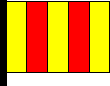
Oil FlagYellow/Red
Slippery Surface
Black FlagBlack
Report to Clerk of Course
Red FlagRed
Cease Racing
Checkered FlagCheckered
End of race
Full Course YellowFull Course Yellow
Cease Racing
Proceed as if under
Pace Car control

The Disciplines

BRING 'EM ON, BOYS. I HAVE MY CATCHER'S MITT READY.

Flagging . . . Vital information

Using the racing flags, turn marshals communicate vital information to the drivers. Most turns on a race track have a flag station. Flaggers work in pairs, with the blue flagger looking up the track watching for faster cars overtaking slower traffic, and the yellow flagger looking down the track watching for any incident that may pose a hazard to approaching cars. The two flaggers stand facing each other so that as well as observing their own areas of responsibility they also guard each other's safety. For a comprehensive description of flagging, refer to the
Corner Marshal's Manual

Timing and Scoring

The position of every car on every lap must be recorded in an accurate and timely manner. Usually located in the control tower, Timing and Scoring workers use a combination of electronic and manual systems to keep track of the field. Accuracy is critical. The slightest error could wreak havoc with the results of an event.

Communications . . . Critical to the track

Efficient communications are essential to the operation of a safe racing environment. Each flag station around the track has at least one Communicator assigned to the team. Using a two-way radio system incidents are instantaneously reported to Race Control and other flag stations around the track. Safety is the primary concern. If the track is blocked or emergency assistance is required this information must be relayed, and the appropriate action taken, as quickly as possible. A complete Communicator's Manual is available on this website

Emergency Response . . . Safety first

The emergency or quick response marshals are the first on the scene of any racing incident. Safety is their primary concern, and they must make a quick and accurate assessment of the condition of the driver, the hazards to other drivers, and the necessary course of action to handle all these elements and get racing back underway as quickly as possible. Information is relayed back to the Communicator via hand signals, and while the flaggers keep the drivers abreast of the situation the emergency response crew may be fighting fire, moving the race car to a safe location, and assisting the driver out of the car. Medical assistance is provided by ambulance personnel or a doctor when needed.


SAFETY FIRST: OUR DAUNTLESS RESCUE CREW IN THE THICK OF THINGS . . .

Technical Inspection

Every race car is inspected for compliance with safety rules before being allowed on the track. Likewise the drivers must present their fire suit, underwear, shoes, gloves and helmet for inspection to ensure they meet current safety standards. The 'Tech' inspectors also weigh cars at the end of qualifying and races to ensure compliance with minimum weight requirements, and examine any car that has sustained crash damage, noting in its log book the extent of the damage and repairs that must be made before the car may compete again. They are very knowledgeable about both the cars and the rules, and help to keep the sport as safe as it can be.


Training

One of the most important functions of the WCMA is our marshal training program. This teaches the basics of turnworking: flagging, communications, quick response, timing and scoring and other positions. Training is ongoing every day at the racetrack. A new worker will be matched with an experienced worker on the corner. New people can get right into the action without being placed in a situation for which they're not prepared.

In addition, extensive training seminars in such areas as first aid, response, firefighting and rescue are conducted -- usually in the spring of each year -- at local racetracks.


WCMA Licences

Though not yet required to work at most Canadian racetracks, a licence is an important document for the track worker. This is the document which proves your level of ability to new people at new tracks.

The Western Canada Motorsport Association (WCMA) issues licences to Track Marshals which reflect their level of experience, their specialty, and their training. A Marshal's logbook is included along with the licence, and this is an essential tool for the Track Worker who'd like to progress to professional and international racing.

A Licence Application Form can be found on the WCMA website. The cost is minimal, and the benefits are substantial. All workers are strongly encouraged to obtain a WCMA licence.

Questions?

If you have any questions or concerns, please don't hesitate to contact us. We'll be pleased to answer them.


"I don't care. This one's gonna cost him TWO cases of beer, Andy . . ."

Worker Resources/Manuals

Many people from a number of different organizations have prepared and maintained the following manuals and articles for racetrack workers. These are not "official" manuals. Racing rules and procedures may vary from region to region and can differ somewhat for any specific race. The manuals, however, form an excellent general guide to Racetrack Marshaling worldwide. Hundreds of manuals such as these exist, but these are amongst the best.

For the most part, these manuals have been prepared over the last 20 years by the people of the Alberta Race Car Worker's Assn. (Currently ARCA)

REQUIRED READING for turnworkers.


Last Updated: January, 2016 by: Raymond Wintonyk